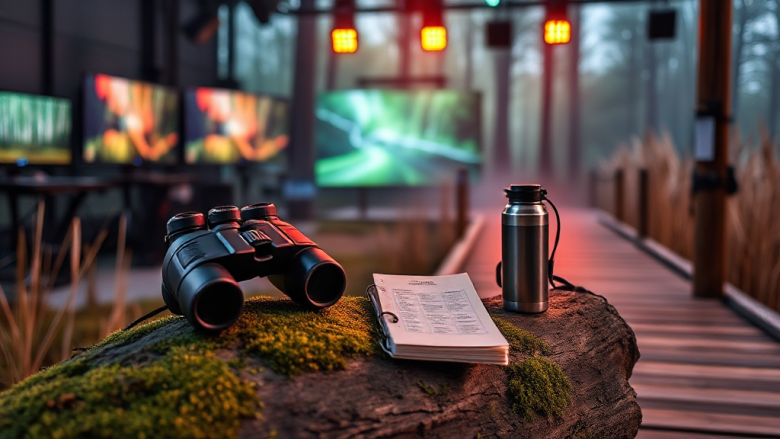
Birdwatching has always been a slow hobby. You stand still, you wait, and eventually something small and brown moves in the hedge. But the culture around it is moving quickly. The birdwatching trends to watch in 2026 are less about new species and more about how people find, record, share, and protect the birds they see. Optics keep improving, apps keep learning, and the community keeps arguing about what counts as a proper sighting. If you have been birding for years, some of these shifts will feel overdue. If you are new, they will shape how you start.
Here are the trends that will matter most over the next twelve months, from the quiet return of paper notebooks to the loud rise of sound-based identification.
Technology Is Getting Quieter and Smarter
The most obvious shift is in the tools. For a decade, birding tech meant a phone app that tried to identify a blurry photo of a sparrow. That era is ending. In 2026, the interesting work is happening in sound and in passive recording. Small, cheap acoustic sensors are being left in gardens, allotments, and local nature reserves for weeks at a time. They pick up dawn choruses, night migrants, and the odd fox. The software then sorts the recordings and flags anything unusual.
This matters because most birds are heard before they are seen. A warbler in a willow is often a voice and a silhouette. Acoustic monitoring turns that into data. It also lowers the barrier for people who cannot get out at dawn, or who live in flats with a single window. You do not need to be a field ecologist to run a sensor. You need a spare windowsill and a bit of patience.
What to watch for: more local groups pooling acoustic data rather than competing over it. The first proper arguments about privacy and noise pollution from garden sensors. And a slow decline in the number of people who claim a sighting purely because an app said so. The apps are getting better, but they still mishear a blackbird as something rarer. The etiquette is catching up.
Optics are changing too, but less dramatically. Binoculars are getting lighter and sharper at the budget end, which is good news for anyone who does not want to spend a month’s rent on glass. The real innovation is in stabilisation and in low-light performance. Birding at dusk is no longer a guessing game.
Community Birding Is Replacing the Lone Listicle
For a long time, birdwatching was presented as a solitary pursuit. One person, one pair of binoculars, one notebook. That image was never quite true, but in 2026 it is actively misleading. The hobby is becoming social in ways that are practical rather than performative.
Local patch groups are the clearest example. Instead of driving two hours to a famous reserve, more birders are committing to a small area near home. A park, a stretch of canal, a cemetery, a school field. They visit weekly, sometimes daily, and they record everything. The result is a detailed picture of how a single place changes through the year. It is unglamorous and genuinely useful. It also builds a community around a shared place rather than a shared tick list.
This trend is partly driven by cost. Petrol is expensive, trains are unreliable, and not everyone can take a day off to chase a rarity. But it is also driven by a change in what people want from the hobby. Less competition, more noticing. The patch birders are the ones who find the oddities first, because they know what normal looks like.
What to watch for: more informal mentoring. Experienced birders taking beginners out on their local patch, not on a grand tour. The rise of the “patch year list” as a respectable alternative to the national one. And a gentle pushback against the culture of twitching, where a rare bird draws a crowd that tramples the habitat. That debate will get louder in 2026, not quieter.
There is a practical side to this too. Shared sightings mean shared transport, shared hides, and shared costs. It is a quieter kind of community, but it is spreading.
Conservation Is Becoming Part of the Hobby, Not a Side Note
Ten years ago, you could separate birdwatching from conservation. You watched birds, and someone else did the science and the lobbying. That separation is gone. In 2026, the two are tangled together, and most birders seem fine with that.
The reason is simple. The birds are changing. Species that were common in southern England are moving north. Species that were rare are turning up in gardens. The seasons are less predictable. A mild winter means different arrivals. A wet spring means different breeding success. Birders notice this before the official reports come out, because they are outside every week.
So the hobby is absorbing conservation work. Gardeners are leaving seed heads standing through winter and digging ponds the size of a bath. Local groups are mapping swifts and house martins, because those birds need very specific nest sites and those sites are disappearing. Recording schemes are no longer just for the keen. They are how the data gets collected.
What to watch for: more birders involved in habitat management, even in small ways. Fewer manicured lawns, more messy corners. A growing interest in insects, because birds need them. And a sharper conversation about cats, windows, and light pollution. Those are not abstract issues if you are watching a fledgling blackbird in your own garden.
The other shift is emotional. Birders are talking more openly about loss. The absence of a species you used to see is a real thing, and people are naming it. That honesty is making the hobby more human, and it is drawing in people who might otherwise have found birding a bit cold.
Travel, Gear, and the Slow Return of Paper
Birding travel is changing shape. The long-haul, high-cost trip is still there, but it is no longer the default aspiration. In 2026, more birders are looking at closer destinations, shorter trips, and slower itineraries. A week in a single valley beats a fortnight of airports and minibuses. The logic is partly environmental and partly practical. You see more when you stop moving.
There is also a renewed interest in local specialities. The birds on your doorstep are as interesting as the ones on the other side of the world, if you look properly. That sounds like a cliche, but it is driving real changes in where people go and what they book. Small guesthouses near wetlands and woodlands are doing better than they were. Big tour operators are offering shorter, more focused trips.
Gear is following the same pattern. Lighter, simpler, more repairable. The market for second-hand binoculars is growing, which is good for beginners and good for the planet. People are less interested in owning the newest thing and more interested in owning something that works.
And then there is paper. Field notebooks are back. Not as a rejection of technology, but as a complement to it. Writing down what you saw, where, and when, in your own handwriting, makes you look more carefully. It also creates a record that does not depend on a battery or a subscription. In 2026, expect to see more notebooks in more pockets, alongside the phone that is quietly recording the dawn chorus.
What to watch for: more birding festivals in small towns, not just big cities. A rise in “slow birding” as a phrase, even if the practice is older than the name. And a continued blurring of the line between a birding trip and a walking holiday. The two are becoming the same thing, which is probably how it should be.
The outlook for 2026 is not about a single breakthrough. It is about a hobby that is getting quieter, more local, more collective, and more honest about what is being lost. The birds are still the point. But the way we watch them is changing, and mostly for the better. If you want to keep up, you do not need new gear. You need a local patch, a notebook, and a willingness to listen.